

Hip extensions on a Roman bench
Natalia Gadzicka Mar 14, 2024 · 5 min reading time
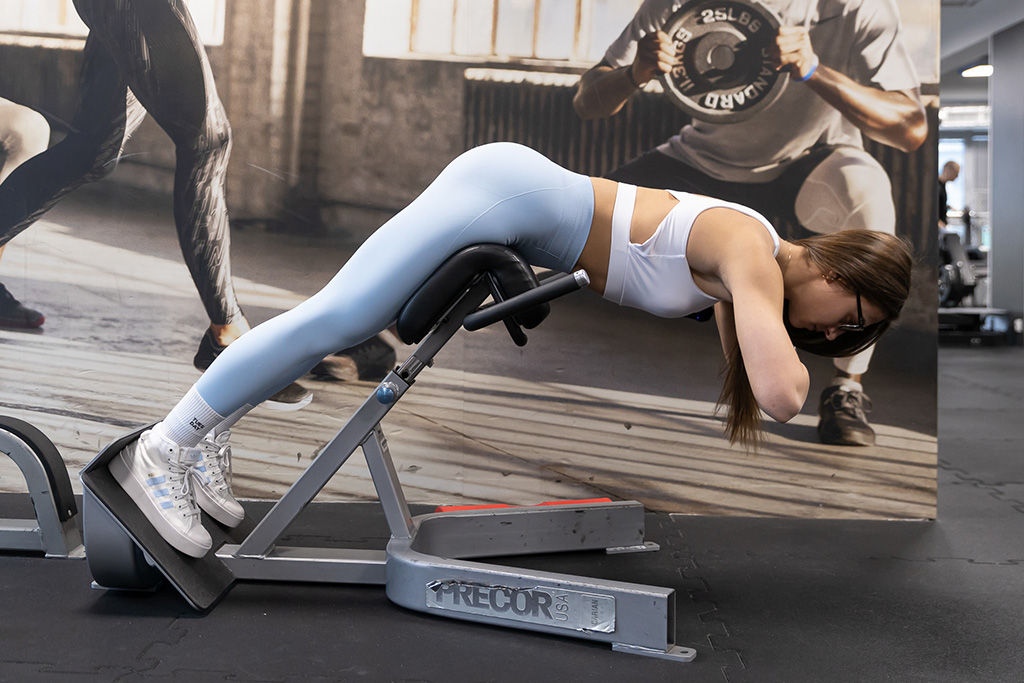
Hip extensions on a Roman bench are an exercise that, depending on the method of execution, involves, to a greater or lesser extent, among others: gluteal muscles and hamstring muscles.
Hip extensions on a Roman bench are an exercise that, depending on the method of execution, involves, to a greater or lesser extent, among others: gluteal muscles and hamstring muscles.
Gluteal muscle group
For the prime mover in this exercise to be the gluteal muscles, the eccentric phase, i.e. the hip flexion movement, should be performed until a maximum of approximately 45 degrees of hip flexion is achieved with straight knees (Fig. 1) or throughout the full range of motion while maintaining 15-30 degrees of flexion in both knee joints (Fig. 2). In both cases mentioned above, the concentric phase, i.e. the extension movement in the hip joint, should end when full hip extension is achieved.

Hamstring group
The muscles of the hamstring group include:
- semitendinosus muscle
- semimembranosus muscle
- and the biceps femoris muscle.
It is worth noting that the short head of the biceps femoris muscle will not perform any work in this exercise. This is because, unlike the long head, it is single-jointed and does not pass through the hip joint, which means that there is no work performed during movements in the said joint.

Regionalization of work within the hamstring group
If we want the hamstring muscles to do the most work, we should extend the hip through the full possible range of motion (Fig. 3) while keeping the knees straight. This version allows all bi-joint hamstring muscles to experience stretch-mediated hypertrophy.

It is also possible to focus the work more strongly on the biceps femoris muscle or on the semitendinosus and semimembranosus muscles. For this purpose, appropriate hip rotation should be adopted, which is confirmed by the literature. Adopting external rotation (Fig. 4) will increase the involvement of the biceps femoris muscle, and internal rotation (Fig. 5) will increase the involvement of the semitendinosus and semimembranosus muscles.


Summary
| buttocks | hamstring group* |
| straight knees + hip flexion up to 45 degrees. | straight knees + full range of motion + internal rotation = semitendinosus and semimembranosus |
| knees bent (15-30 degrees) + full range of motion | straight knees + full range of motion + external rotation = long head of the biceps femoris muscle |